
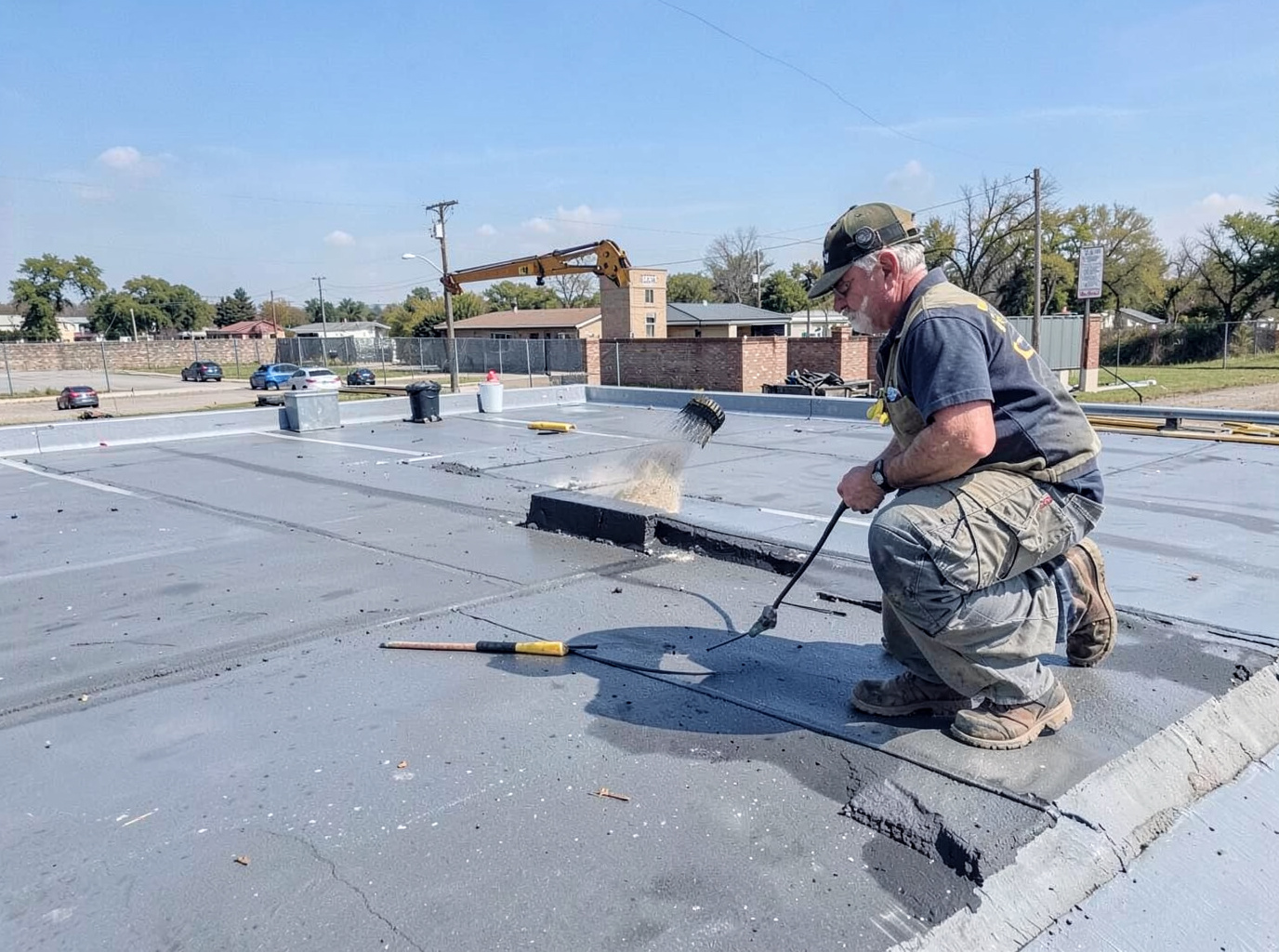
Commercial flat roofs in Killeen face accelerated wear from ponding water after thunderstorms and thermal expansion during long hot summers. Buildings in Downtown Killeen and along the corridors toward Harker Heights often use older TPO or modified bitumen systems that develop seam failures and blistering when drainage slopes are inadequate. Proper repair requires identifying whether the substrate has absorbed moisture and whether edge details at parapets need rebuilding to meet current Bell County wind-load expectations.
Technicians working these roofs must account for the mild winters that allow year-round access yet still bring sudden temperature swings that stress flashings around HVAC curbs and skylights. In Copperas Cove and near Long Branch Park, many low-slope commercial structures sit on slightly uneven terrain that funnels runoff toward one side, creating chronic low spots. Repair crews therefore focus on restoring positive drainage rather than simply patching surface cracks, because standing water quickly degrades new material in the next storm cycle.
When leaks appear near Killeen City Hall or in retail strips serving commuters to Temple and Waco, the first step is a core cut to check insulation saturation. Heat-reflective coatings applied over existing membranes can extend service life only if the underlying deck remains dry; otherwise moisture becomes trapped and leads to larger failures. Local crews carry tapered insulation and pre-formed crickets sized for the common 1/4-inch-per-foot slopes found on 1980s and 1990s commercial stock in the area.
Technician insight
In Killeen the thing that catches most people out with Commercial Flat Roof Repair is how summer heat and sudden thunderstorms combine to create hidden moisture under the membrane on buildings around Downtown Killeen and Harker Heights; once water gets under the insulation it travels far from the visible leak, so skipping core cuts almost always leads to callbacks within a year.
Ponding Leak Near Killeen City Hall
A retail building two blocks from Killeen City Hall developed interior leaks after repeated spring storms. Core samples showed saturated insulation along a low valley that funneled water toward one scupper. Crews added tapered crickets, replaced the affected section with matching TPO, and cleared the clogged internal drain line. The roof has remained dry through the following thunderstorm season.
Commercial Flat Roof Repair Services We Offer
✓TPO Membrane Repair
Heat-welded patches and seam reinforcement on TPO systems common to Killeen retail centers, restoring watertight integrity after thunderstorm damage.
✓EPDM Seam Restoration
Adhesive seam sealing and flashing replacement on EPDM roofs in Harker Heights and Copperas Cove to stop wind-driven rain intrusion.
✓Modified Bitumen Patching
Torch-applied or cold-process patches on modified bitumen roofs serving older commercial buildings near Downtown Killeen.
✓Roof Drain Clearing and Repair
Scupper and internal drain cleaning plus strainer upgrades to prevent ponding on flat roofs throughout Bell County.
✓Elastomeric Coating Application
High-solids acrylic or silicone coatings applied over existing membranes to reflect summer heat and seal minor cracks.
✓Flashing and Edge Detail Repair
Parapet wall, curb and perimeter flashing replacement to handle wind uplift common during Killeen thunderstorms.
Commercial Flat Roof Repair Cost in Killeen, TX
| Service | Typical Range | What Affects It |
|---|---|---|
| Initial Roof Inspection | Free | Includes moisture scan and written report for Bell County commercial properties. |
| Small Membrane Patch | $450–$950 | Per 4x4 ft area; price rises with TPO versus modified bitumen. |
| Drain Cleaning And Repair | $300–$650 | Depends on access and whether internal piping needs work. |
| Elastomeric Coating | $1.80–$3.20 per sq ft | Varies by coating thickness and number of coats required. |
| Full Edge Flashing Replacement | $18–$32 per linear ft | Includes new metal and membrane tie-in on typical parapet heights. |
Ranges are typical for Killeen, TX and confirmed with an exact written quote before any work starts.
How it works
- 1
Site Inspection
Core samples and moisture scans are taken across the roof deck while noting drainage patterns and existing membrane condition.
- 2
Damage Mapping
Technicians mark all blisters, seam separations and low spots, then photograph areas for the property owner.
- 3
Material Preparation
Matching membrane, tapered insulation and compatible adhesives are staged on-site to match the existing system.
- 4
Repair Execution
Patches are installed, seams welded or adhered, and new flashings added before a final flood test confirms drainage.
- 5
Documentation Handover
Before-and-after photos plus maintenance recommendations are provided for the building file.
Pricing
Quotes are provided after an on-site inspection; costs vary with roof size, membrane type and extent of moisture damage.